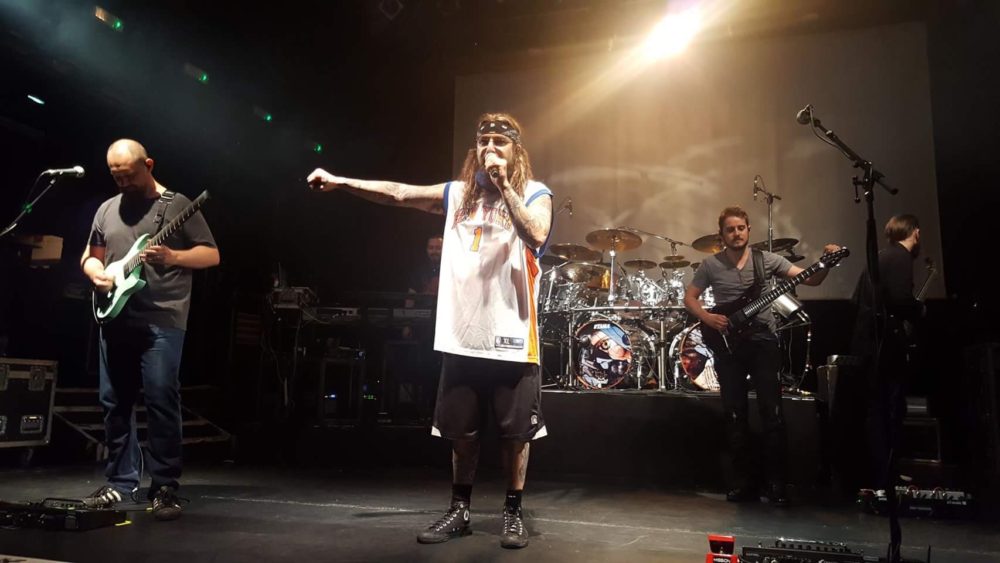
by progrock.com | Jul 3, 2017 | Reviews
Show: Mike Portnoy’s Shattered Fortress w/Next To None
Venue: Koko, Camden UK
Review by: Faye Sanderson
Photos by: Marco Segafreddo
Mike Portnoy, drummer extraordinaire and founder/ex-member of progressive metal heavyweights Dream Theater, is back on tour. Only this time, instead of touring with one of the many bands he’s been part of since he left Dream Theater in 2010, Portnoy is bringing thirsty audiences a full rendition of his ‘Twelve Step Suite’: a suite of five songs spanning five albums over seven years. The twelve-step suite charts his progression through the twelve steps of the Alcoholics Anonymous programme, a group therapy he credits with his ongoing recovery from alcoholism (it’s been seventeen years since his last drink). The suite is ambitious, taking us into the darkest recesses of Portnoy’s struggle with addiction, from admitting his powerlessness over alcohol to reaching a place where he’s now extending the hand of support to fellow recovering alcoholics.

Minus the rest of his old bandmates in Dream Theater, Portnoy has recruited another group of phenomenally talented musicians in the form of five sixths of Haken (minus drummer Ray Hearne) and American guitarist Eric Gillette (Neal Morse Band) to bring this ambitious, once in a lifetime event to fans across the world. On Wednesday night, Portnoy’s Shattered Fortress tour kicked off in London’s Koko. There’s a special kind of delight in being the first audience of a tour and not knowing what to expect, for those of us (especially myself!) who are unable to resist checking setlists before the night. I knew it was going to be an awesome night from the moment we filled into the venue and several rows of fans started up impromptu karaoke to the house music, instrumental versions of well-loved Dream Theater songs. Anyone who’s attended a Dream Theater gig prior to 2010 knows the camaraderie felt at a Dream Theater show is something special, and it was amped up to the max by knowing we were going to see this music performed by Portnoy himself, the heart and soul of Dream Theater that’s been sorely missed since his departure.
Support came in the form of Next to None, with Portnoy’s son Max on drums. For those concerned their place on the tour was purely due to the family connection, fears were laid to rest within the first couple of songs as N2N showed us their infectious enthusiasm and insane chops; guitarist Derrick Schneider is surely one to watch, bringing both excellent playing and soaring, clean vocal harmonies to the mix effortlessly. I saw them support Haken on a recent tour and there’s been a clear improvement in their stage presence in just a few short months: give them a few years to further hone their songwriting skills and continue to mature and they’ll be ones to watch.

The main event arrived, and we were thrust back into Dream Theater’s glory days with the opening from what is arguably their most revered album Metropolis Part II: Scenes From a Memory (1999), the concept album by which all others have been judged in the past thirteen years since I first fell in love with it. To say this was a surprise is an understatement, one which left my friend and I shouting to one another ‘is this actually f*cking happening!?* in disbelief as tears formed in my eyes. The beauty of Overture 1928 and Strange déjà Vu is in the way opening instrumental passage gives every musician chance to take centre stage for solo melodies, a true display of the musicianship ahead of us during the rest of the show. If there was any concern that it would be strange seeing DT music played by Haken this was put to rest within seconds: not only are they more than capable of nailing the complex rhythms and technically demanding lines inherent in Dream Theater, they’ve made it known on social media they’ve long been massive fans of Dream Theater’s music, growing up listening to them and honing their skills to Dream Theater like so many of the rest of us in the audience. There’s always a danger that something is lost in translation when music you love is played by a new group of people, but the love that every single member clearly felt for what they were playing was impossible to miss even for fans who’d never heard of them before. Haken are renowned for bringing a huge party to their shows (having been lucky enough to see them several times before myself), so the mix of them with Portnoy and the astoundingly competent Eric Gillette created a gig with levels of excitement and showmanship often missing in what some see as the navel-gazing, introspective nature of the progressive genre. It was beautiful to see a band of musicians paying tribute to the music of their youth, and the knowledge that they were fans as much as those of us watching leant a strangely intimate atmosphere where it felt like everyone was in it together.

Moving on, 1994’s The Mirror bridged the gap between the optimistic vibe of Scenes and the darker, heavier twelve-step suite ahead. Kicking off with the Glass Prison, crafted to show us exactly how it felt for Portnoy to feel trapped inside his addiction, fan hysteria seemed to hit a record high for the night with every last person I could see around me singing each line word and visibly anticipating and responding to every single lick, sweep, pinch harmonic and drum fill like only die-hard fans of Dream Theater are able to.
Second in the suite is This Dying Soul from 2003’s Train of Thought, Dream Theater’s Metallica-infused, heaviest, darkest record to date, giving everyone plenty of opportunity to develop a sore neck the next day. Third up, The Root of All Evil, we were treated to seeing guitarist Eric Gillette handle all vocal duties, a nice move which switched things up a little and no doubt gave singer Ross Jennings chance to catch his breath from what must surely be one of the most demanding singing gigs of his career. The penultimate track, Repentance, is a brief but much-needed lull which gave both the band and audience chance to sit back for a moment and enjoy the few minutes break in headbanging and jumping around. Repentance deals with the AA steps which involve making amends for your sins and seeking forgiveness for those you have wrong, and features prog legends Steven Wilson and Mikael Akerfeldt apologizing for their mistakes during the middle passage of the track. A particularly delightful moment came when their faces floated across the screen behind the stage, leading to them both getting their own individual and hearty rounds of applause and cheers.
The final song of the suite came in the form of the Shattered Fortress, a song which somehow manages to weave in myriad themes and melodies from the previous four tracks, while adding enough new material that it sounds triumphant and complete rather than derivative. My favorite song of the suite for many reasons, it’s hard to describe the way an already brilliant song became transcendent when performed at the end of the forty-four minutes of music which gave life to it. I can only try and imagine how it must have felt to be Mike Portnoy at that moment, seeing 1400 fans singing back at him his own determination to extend support and guidance to other alcoholics at the beginning of their own journey into recovery.

by Simon Robins
There are no real words that can do justice to how much it meant to finally see one of my favorite pieces of music performed live after giving up all hope of ever being able to do so when Portnoy left the band (though the length of this review kinda counteracts that claim). Though Dream Theater have carried on and have my enduring respect for all that they’ve created, the atmosphere at their shows has been lacking ever since Portnoy soul walked out of the door. Seeing the show tonight made me realize that although I’ll always follow Dream Theater whatever path they take, the magic that made them the greatest band in the world was contained within Mike Portnoy. It says a lot that this was more of a Dream Theater gig like I used to know and love than any of the shows I’ve seen without Portnoy. For one fifth of the band and a bunch of his friends to pull this off truly says it all.
Unsure what to expect from the encore, I waited with bated breath until the band came back on stage and kicked off with one of the highlights from Scenes from a Memory, Home, before playing the revered The Dance of Eternity. Notorious amongst the world of progressive metal for its insistence on changing time signatures every bar or two and requiring some of the most technically complex solo parts heard from Dream Theater (which says a lot), The Dance of Eternity was, I thought, a clear display of prowess which cemented my view that Haken are possibly the most underrated musicians in modern prog music, especially keyboard player Diego Tejeida who was, along with Eric Gillette, undoubtedly the star of the show the whole gig for his note-perfect performance and bombastic, wonderfully over the top keytar solo sections. Having watched a few fan videos back on YouTube while writing this review, I was struck again by how skillfully he was able to interpret and play 2+ hours of some of the most physically and mentally demanding keyboard work in the genre. Though most of the show was spent watching him play, it was one of those rare gigs were there wasn’t a weak link within the band.
The gig ended, fittingly, with Finally Free from the end of Scenes from a Memory, nicely bookending the show. I remembered to look around me before the end of the song, and saw how every single person in the audience was stood, mesmerized, singing along, plenty with tears in their eyes. It felt just like the many times I saw Dream Theater with Portnoy, where the audiences all seemed to feel like they were in something together, finding something within Dream Theater’s music they possibly (like me) had never found elsewhere. Dream Theater fans are nothing if not a community, and it was bittersweet to see that despite all of the water that’s passed under the bridge in the band’s recent history, the love for their music prevails and is utterly timeless.

So there you have it. I went expecting the twelve-step suite, I came away with that plus five songs from Scenes from a Memory, with more atmosphere and energy and meaning than any of the occasions I’ve seen Dream Theater play in recent years. For myself, their seminal concert DVD Live Scenes from New York has always been the ultimate gig DVD and one which expresses and captures perfectly the emotions that first caused me to fall hopelessly for Scenes. I’ve spent years ruing the fact that I wasn’t at that particular gig, but tonight genuinely felt like we got our own version of Live Scenes from New York: a gift I presumed would never come since the parting of Portnoy from the band. I’m unashamed to say that my mascara was running as the band left the stage, and I felt certain that I’d never be fortunate enough to experience a show or experience like it again in my lifetime.
Portnoy has stated that after this tour, he will no longer be playing Dream Theater’s music, citing it as closure for him. If you’re a fan of the band and able to get to any of their dates for the rest of the tour, you won’t be disappointed. As sad as it is to think that this is something I’ll never be able to experience it again, the fact I experienced this gift at all is something I’ll cherish within my heart for the rest of my life as an evening shared with friends old and new watching some of the most emotionally deep, meaningful, personal music I’ve ever been lucky enough to find and fall in love with. Portnoy took a risk putting together this tour and putting himself out there by playing Dream Theater music while the rest of the band are still writing and gigging and attracting their own huge audiences, but it paid off better than I could have possibly imagined. If this is his closure, he now knows that however long he spends away from the band he grew and nurtured and turned into the international success it is today, we fans will always be grateful for everything he gave the world of music and that he has our enduring love and respect. It takes guts to take your own intimate battles and set them out for others to consume and critique, but what Portnoy has achieved with the Shattered Fortress tour is a triumph.”


by Mark Monforti | Jan 3, 2017 | Reviews
If you have never read the key for my ratings below please do so one time. I feel my ratings are tougher than my peers. Also Check my last.fm link to see how compatible our music tasts are.
This is the first time I am hearing of this french band. I am really impressed by it. I later found out that they played summers end festival this year.
Their sophomore release is full of crunchy guitar's and outstanding female vocals by Laetitia who is influenced by Anneke Van Giersbergen but I can't help but hear Christina Booth at times.
Dripping with drama this is album is right up my alley and will surly be loved by fans of The Gathering and Magenta.
Check it out for yourself. Request a track (After Release date 02-Feb-2018)
[usrlist "PREVIOUS BAND RATING:4" "ACCESSIBILITY:3" "HEAVINESS:2" "MELODIC:3.5" "ARTWORK & PACKAGING:4" "DRAMA:4" "OVERALL RATING:4"]
Click Below to purchase at Amazon US or Amazon UK and we’ll get a little referral bonus on your whole order. Even if you don’t order this album
Key:
These ratings are just attributes and may not have correlation to the most important: OVERALL RATING
PREVIOUS BAND RATING
0: Never heard of them or debut album.
1: Someone recommended. I give them another shot.
2: Some good moments in the past but never put together an album I really liked.
3: Some 4 or 5 star songs but albums can be hit or miss for me.
4: I like 80% of their songs and probably went to see them live.
5: I would, and probably have gone on a plane to see them live.
ACCESSIBILITY EXAMPLES
1: Weather Report
2: Zappa
3: Genesis – Selling England by the Pound,
4: Marillion – F.E.A.R
5: Kino – Picture
HEAVINESS EXAMPLES
1: IQ – Seventh House
2: Discipline – Unfold Like a Staircase
3: Porcupine Tree – In Abstentia, Shadow Gallery – Tyranny
4: Vanden Plas – Chirst 0, Dream Theater – Scenes From a Memory
5: Opeth – Black Water Park
MELODIC EXAMPLES:
1: Opeth – Black Water Park
2: Vanden Plas – Chirst 0, Dream Theater – Scenes From a Memory
3: Porcupine Tree – In Abstentia, Shadow Gallery – Tyranny
4: Discipline – Unfold Like a Staircase
5: IQ – Seventh House
OVERALL RATING:
1: Will Never listen to again and deleted under no circumstances should you buy this
2: Not my thing maybe one redeeming song.
3: I like parts of this and I would check them out if they were near me.
4: I would get in the car and road trip to see this album live
5: I would get on a plane to see this performed live
See if our likes are similar See my Last.fm Page
https://www.last.fm/user/mon40/library/artists

by WPaPU-Nick | Mar 14, 2016 | Reviews
Band: Haken
Album: Affinity
Available: April 29th via InsideOut Music
Reviewer: Nick from When Prog and Power Unite
Audio Review
Haken Website
Order the Album
It doesn’t seem that long ago that a close friend from across the pond sent me the demo of his brother’s band, Haken. Pete Jones would leave the band before they released their debut album, but it was due to his brother that I became aware of an amazing young band. I continued to promote Haken through the release of Aquarius in 2010, and was thrilled when they won the album of the year poll amongst our listeners. In the six years since, the band has seen a meteoric rise in popularity amongst progressive metal listeners, going from obscurity to festival headliners in only a few albums.
The band’s greatest success came with the release of The Mountain in 2013, and given what it did for the band I would have found it difficult to blame them for sticking close to that style when working on their newest album, Affinity. It took only one listen to discover that the band had no interest in playing things safe. Although you might not find any songs as eccentric as “Cockroach King” on this album, as a whole it is brighter and more upbeat than its predecessor. Once the appropriately titled intro track, “Affinity.exe” wraps up, “Initiate” kicks into gear and immediately sets the tone for the album. It’s heavy, but also atmospheric, and serves as a statement that Haken won’t be repeating themselves, no matter the intensity level of the music. The current tone of the band is strongly set by the first song.
“1985” is, understandably, the biggest nod to the 80’s music that inspired parts of this record. Although Diego Tejeida’s keyboards certainly play close to that era throughout the record, it is definitely most notable during this track. In nine minutes you meander through a Yes opening, some rockier verses, some instrumental parts, and finally a more typical anthemic Haken chorus. And then there is what can only be called… that part. That glorious moment in the song that sounds like the mix of music from a 1980’s montage scene sprinkled with sounds from the 1990’s video game adaptation of that same movie. Make no mistake, you’ll know when you get to it. The next track, “Lapse” offers a strong vocal performance and guitar solo, but doesn’t rise to quite the same heights as the rest of the album.
On my first listen to Affinity, I had turned my attention away from my computer screens for a while, and heard an ominous intro, and thought, “this has to be the big one”. Sure enough, a quick check told me I had moved onto the 15+ minutes of “The Architect”. Haken have thrown a longer song onto every studio album, including the Restoration EP, and so this song will naturally draw comparisons to its contemporaries. It is probably both more reserved and yet more experimental than the other epics. Chorus aside, it does lack the bigger hooks of some of the other long songs, but it hits on genres and styles outside of what we’ve seen with Haken to date. This genre push, though usually minor in its use, includes post-rock, dubstep, electronica, and some corners of metal the band has never before explored. Einar Solberg from Leprous has a short guest appearance in the song, providing expertly performed harsh vocals, but much like the rougher vocals on Aquarius, I found them to be an unnecessary addition. The band’s full time vocalist, Ross Jennings gives one of his best performances on this track. Through this song, and on the album as a whole he sounds fantastic, but on some tracks he’s pushed to a style with such a high tone that enunciation can become an issue. When it’s all said and done “The Architect” promises to be just as rewarding as its peers, even if I think it’ll take people a few extra listens to come to that conclusion.
After the length and density of “The Architect” it seems we are treated to an intentionally placed, and short poppy track in “Earthrise”. Given its ease of listen, and the fact it’s one of the shorter tracks, I’d be shocked if it isn’t used to help promote the album. But do not fret when I use the words short and poppy, as this is a great track, showcasing a lot of what this latest offering is all about in a compact wrapper. The opening verse features guitar parts from Richard Henshall and Charlie Griffiths have a clean and joyful electric tone to them that were a treat to hear added to the Haken sound. Speaking of the axe wielding duo, their contributions to the album can best be described as well blended. The incredible leads are there, but often lowered in the mix by Jens Bogren, given the compositions a beautiful wholeness. While there are not too many solos or 6-to-7 string acrobatics screaming for attention, but thoughtfully crafted songs certainly do not fail to draw your attention.
“Red Giant” takes a break from the bulk of the albums 80’s look-back approach and infuses many of the genre-expanding influences I mentioned earlier. While it is six minutes of the most experimental music on the album, it can get lost amongst the catchiness of the previous track, and the stellar next track, “The Endless Knot”, which is one of the best songs on the album. ”The Endless Knot” begins with a guitar and keyboard led intro, and then drummer Ray Hearne takes things over, offering a tom and bass driven bounce that sets the tone for the rest of the track. About midway through the song we are treated to a dubstep-adjacent section that manages to keep the groove wonderfully, and then exits into a fantastic bit of guitar work. “The Endless Knot” clocks in at 6 minutes, and is one favorite Haken songs to date.
The final track, “Bound By Gravity”, is a touching outro to the album, and perhaps the track that most closely resembles the softer sections of Affinity’s full-length predecessor. The vocals are soft and soothing throughout, as is the music for the most part. Light chimes (or at least their keyboard counterpart) aid the calm early on, and when the music picks up in the latter portion of the track, they change to tubular bells, making an epic ending to the song and the album.
This album has songs that stand apart from one another, and from their past works, propelling the band into the next chapter of their career. While Affinity may have very slight lulls in “Lapse” and “Red Giant”, every other song is memorable and top of the line, forming a great album. The stylistic changes are refreshing and brilliantly executed.
Through all of this I’ve failed to mention the newcomer and sole American in the band, bassist Conner Green. Affinity was his first chance to appear on brand new Haken material, and the results were similar to the Restoration EP. A tone that is warm, clear, and mixed incredibly well, while his playing glues the songs together. While it may not pop out at you at instantly, anyone who pays attention to his playing will have plenty to be excited about for Haken’s low-end future. As good as he was, however, the standout star on this album is clearly Diego Tejeida, who took the demands of the 80’s style, as well as the more experimental new styles and brought amazing tones and play to each challenge. Whether the keyboards are aggressive or atmospheric, they are always impressive throughout this album, and help make it a fantastic part of Haken’s discography. I don’t know if it quite climbs to The Mountain top as my favorite album, but Affinity comes very close.
Nick’s Grade: A
by WPaPU-Nick | Feb 18, 2016 | Reviews
Band: Steven Wilson
Album: 4 ½
Reviewer: Joe from When Prog and Power Unite
Audio Review
Steven Wilson Website
Buy on Amazon
Over the last several years, the world of progressive rock has been dominated by the sound and vision of Steven Wilson. Not only has he created some of the most compelling progressive music over the last decade, but he has also been one of the genre’s most prolific artists, churning out four studio albums, two live albums, and three EPs over the last seven years – and that’s not counting all the material Wilson has mixed, produced, or worked with outside the confines of his solo band. 4 1/2, the latest Steven Wilson release, is an album-length EP that is meant to be a bridge between the project’s fourth and fifth albums, while reaching for material from his third and fourth albums.
Unlike prior Steven Wilson EP’s, 4 1/2 is mostly comprised of music that has not been heard before. This is in contrast to the last EP, Drive Home, which felt more like a single enriched by a b-side and a generous supply of live recordings. 4 1/2 also features music recorded both before and after the Hand. Cannot. Erase. session, with one song being a “The Raven That Refused to Sing” leftover, and others being newer compositions that feature members of Wilson’s current touring band on record for the first time.
The EP will certainly be enjoyable for Wilson’s most ardent fans, as the majority of these compositions would have been nice contributions to their corresponding albums. The EP’s first song, “My Book of Regrets” is a poppy-yet-proggy near-epic detailing the lonely observations of someone living in the city, and harkens back to the thematic subject matter of Hand. Cannot. Erase. in more ways than one. The third song, “Happiness III”, is another song recorded during the Hand. Cannot. Erase. sessions, though it denied my early expectations that it would be a work similar to that album’s “Happy Returns”. Instead, “Happiness III” almost sounds like Porcupine Tree – it’s the type of simple and catchy alt-rock flavored short song that wouldn’t be out of place on Lightbulb Sun.
If there’s a shortcoming, it’s that this EP is really more of a collection of leftovers than a cohesive work in its own right, and being such, some of the instrumental tracks lack the sort of context that may have made them more enjoyable. For example, “Year of the Plague” is a gorgeous throwback to the haunting, jazz-inspired themes of Raven, but standing on its own, between lighter H.C.E. tracks, I can’t help but feeling like it loses some impact. The same is true for the other instrumentals which, while nice, still feel like out-of-place atmosphere-setters that didn’t make the cut on their home albums.
That leaves us with “Don’t Hate Me”, a rerecording of a Porcupine Tree song based on a live version recently played by Wilson’s solo band. It’s a nice… interpretive cover… but again, the type of thing that is nice to have for documentation’s sake, while remaining somewhat inessential, since I do not think many listeners will prefer this new version of the song to the original.
After several EPs and iterative releases over the years, we’ve rarely seen Wilson make a focused effort at creating a cohesive and enjoyable short work, rather than just a collection of leftover songs and oddities. It’s a good release that many fans will be thrilled to hear, but a little bit more glue might have turned this EP of unrelated works into cohesive whole.
by WPaPU-Nick | Feb 18, 2016 | Reviews
Band: Headspace
Album: All That You Fear is Gone
Reviewer: Nick/Mason from When Prog and Power Unite
Audio Review
Headspace Website
Buy on Amazon
Although we don’t always agree on the how or why, there is no doubt that progress is being made over the years. In the music industry one of the major steps forward I’ve noticed is the ability of bands to put out stellar debut albums. I’m not talking about in the songwriting department, as there are stellar first works from all decades of recorded music. What I’m referencing is the growing ability for anyone, or any band to produce sonically wonderful works thanks to advancements in technology. Because of that, whenHeadspace released I Am Anonymous in 2012, it was not only beautifully constructed, but sonically amazing. Gone are the days of needing to rent out studios full of equipment for weeks, with a large financial investment needed for a top quality product. Now, bands like Headspace can record piecemeal, in different locations, at different times, and make fantastic sounding albums without a monocle wearing executive backing them.
That brings us to the new release, All That You Fear is Gone, which shares in the debut’s excellent production values. This is likely in no small part due to the return of Jens Bogren for the mixing of the album. All that said, a clean recording does not make an album a masterpiece, and there are of course many other factors at play. The songwriting is very similar to the debut, yet still manages to find some new musical ground to explore, rather than staying within the confines of their debut album. Adam Wakeman’s amazing piano and keyboard work follows a similar pattern, as does Pete Rinaldi’s excellent guitar work and Damian Wilson’s highly emotive vocals, and yet they come together in a new fashion. The one change in the band is the drumming of Adam Falkner, replacing Richard Brook, but one might not even notice. The drumming, while not in any way poor, remains the least impactful on the music as a whole. Lee Pomeroy, on bass, continues to use any downtime the other players give him to insert a great bass melody, while providing a strong backbone the rest of the time.
Headspace continue to explore a special ground, throwing in elements of progressive metal of course, but focusing on open and imaginative arrangements and instrumentation. Wakeman continues to excel in using a plethora of well-planned sounds within each song. Within the heavier section of the opening track, “Road to Supremacy” you can hear nearly half a dozen shifts in the keyboards, as the music around them remains more relatively constant. Rinaldi’s electric guitar only occasionally sees anything that approaches a traditional riff, most often staying as loose and moving as the rest of the music. Even a song like “Semaphore”, which tricks you into thinking it’s going to be a straight ahead rocker from start to finish, takes a sharp left turn back into traditional Headspace territory half way through.
All in all I can’t find many bad things to say about All That You Fear is Gone, other than it’s not I Am Anonymous. The band came out of the gates with such a strong punch that it would be hard to follow up, and indeed there is a certain “it” factor that seems to be missing this time around. “Your Life Will Change”, the lead single from the album, does a fantastic job at bridging the gap between the last album and what to expect on the new one. “Polluted Alcohol” and the title track continue to show what the band can do when stripped back. “The Science Within Us” shows the band can still do a fantastic 10+ minute piece. And yet, across the board, everything seems dialed one small step back.
I don’t think anyone who is just getting into Headspace will be disappointed with All That You Fear is Gone. Quite the opposite, in fact, as they still have such a unique identity and special delivery that any new fan should immediately take note. Returning fans will likely experience a slight disappointment, but only because they are coming off the heels of one of the truly special debut albums of this decade. It’s hard to describe what the debut had, that this album lacked, but it lies somewhere in the realm of the merging heavier elements with the unique aspects of the band. And while All That You Fear is Gone manages to have both those elements, they don’t meet and kick into that extra gear quite as often, or as well. It should come as no surprise what a man named Wakeman can do with a keyboard, but you can’t teach imagination and creativity as easily, and Adam brings both in spades. Add to that the fact that for his myriad of projects over the years, this is the one that best utilizes Damian Wilson’s voice, and you have a one-two punch that should make Headspace a band to watch for years to come.
Nick’s Grade: A-
Mason’s Addendum:
Nick took care of the music by in large, but I would like to comment that Damien and Adam have a real mojo together musically, as this is the second album released in 2016 that features them working together – and I believe Adam is also on Damien’s forthcoming solo album as well. One of the great things about both Headspace albums is that both have overarching themes. I loved the stories of personal strife that made up I Am Anonymous, and I like that the band decided to do another album with one overall theme. I think part of the reason I am finding All That You Fear Is Gone just a slight step down is that its theme of trying to control an individual is less relatable in some ways. I can put myself in the shoes of the characters from the debut and experience their reality, whereas it is not possible to do that when songs deal with more abstract ideas.
The other reason I find myself being less wowed by the new album is strictly a matter of my personal taste.All You Fear Is Gone has several softer ballads, varied in structure and sound, so it is not a matter of repetition; I just personally gravitate to heavier elements. Because the sound on this album is more varied, I think it will be a grower for some people. My opinion of it after 10 spins is certainly higher than it was after my first and second one, and even in listening it to it now to write this I am still finding new bits that catch my ear right. My standout tracks are “Kill You With Kindness”, “The Science Within Us”, “The Day You Return”, the second half of “All You Fear Is Gone”, and “Secular Souls”.
by WPaPU-Nick | Dec 13, 2015 | Reviews
Band: Turbulence
Album: Disequilibrium
Reviewer: Annie from When Prog and Power Unite
Find Turbulence on:
Youtube
Facebook
iTunes
Turbulence’s Disequilibrium is nothing short of great. The quintet from Lebanon has a phenomenal blend of melodic prog metal with atmospheric, symphonic melodies to their songs. What strikes me most about this release are how keyboardist Mood Yassin and guitarist Alain Ibrahim are outperforming each other most of the time, but still manage to work as a team that is determined to win a listener. No less great is singer Owmar El Hage, who uses uplifting singing, whereas most modern bands with Turbulence‘s musical style decide to go the growling route. This vocal choice definitely works to Turbulence’s advantage.
Both Ibrahim’s guitars and Yasmin’s keyboards are rough and fiery, yet smooth and cool when they layer clean melodies or intense solos over their riffs. Charles Bou Samra’s bass is extremely punchy and plays well off the guitars. The previously mentioned symphonic elements provide a proficient and vibrant atmosphere throughout the album. The band balances well between the prog metal rockers and more melodic, ballad-y material, which works well.
Disequilibrium is a treat to those who enjoy progressive metal from the 90’s, and early 00’s. The next step will be a huge challenge for the band, and if they successfully pass it, they are onto something really big.
